To choose an AI sales roleplay tool, run one test before anything else. Give the simulated buyer a goal your rep does not know about, then check whether it holds that goal when the rep goes off-script. A buyer that keeps its budget, its authority limit and its competing priority under pressure is practice. A buyer that answers what it is asked, volunteers pain points on request and lets every session end in a win is a chatbot with a sales skin. Almost everything else on a feature list is downstream of that one behavior.
Then match the tool type to your situation instead of picking from a ranking. Teams onboarding reps in cohorts get the most out of a dedicated voice roleplay platform. Teams already running enablement inside a readiness suite are usually better served by the roleplay module they have already paid for. Certification and hiring screens belong on an assessment-first platform, which changes your compliance position the moment a score reaches an employment decision. Sellers who want the drill and the real call on one script set are the case we built CallPrompter for: practice mode runs the same prompter overlay a live call runs, on the same scripts.
Key takeaways
- The deciding criterion is buyer agency: whether the simulated buyer holds a hidden agenda when the seller goes off-script, flatters it, or pushes for a concession they have not earned.
- Agreeableness in language models works against practice, and it is measurable. Across 13 role-playing models tested at ACL 2026, nine showed significant positive correlations between persona agreeableness and sycophancy, with a maximum Pearson r of 0.87.
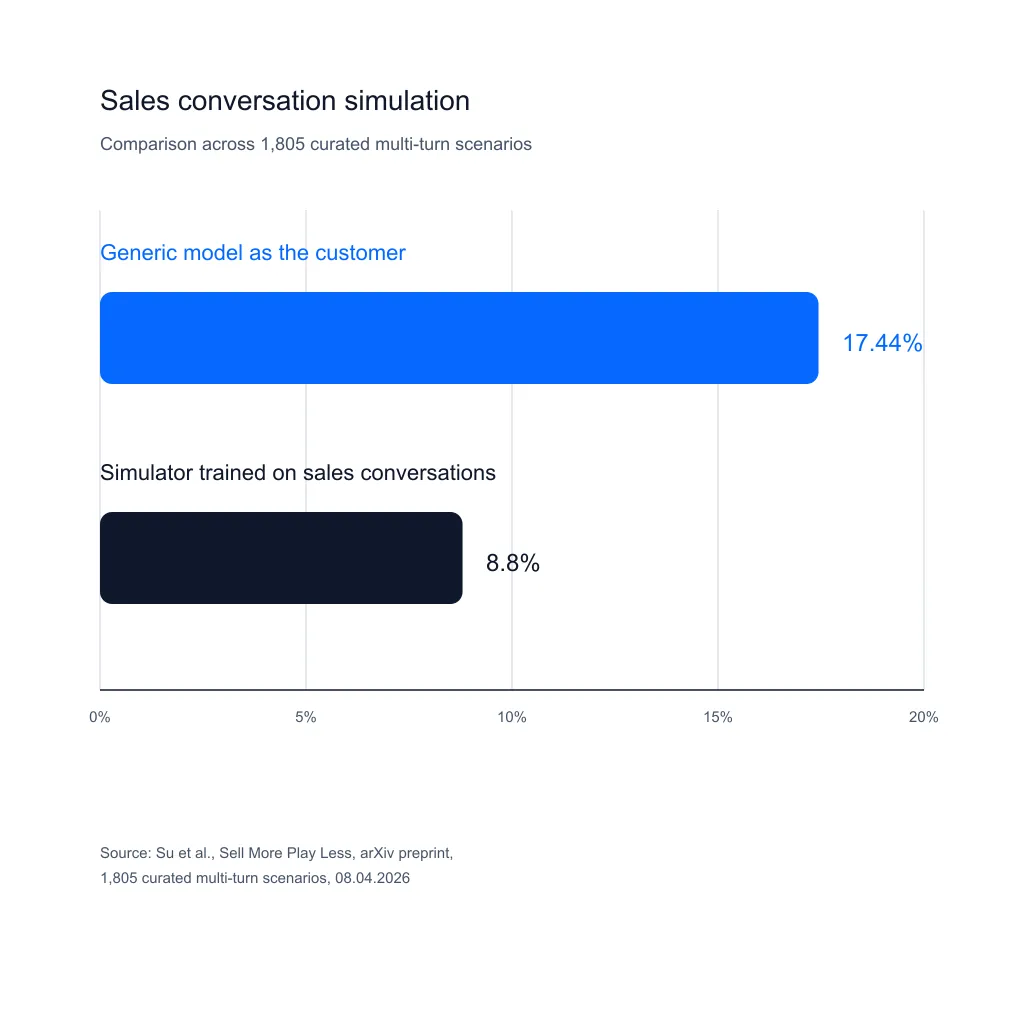
- The simulator decides who looks good. In a 2026 sales benchmark, role inversion occurred in 17.44 percent of dialogues with a generic model playing the customer, against 8.8 percent for a specialized simulator.
- Set the expectation low. The most direct field evidence for AI roleplay reports an average performance effect of roughly 2 percent, with larger gains for lower prior performers.
- The category’s viral retention figures are unsupported. The 75 percent versus 5 percent claim comes from the learning pyramid, and the organization usually credited with it reported it could locate no research behind the numbers.
- A published latency number means nothing until the vendor names the interval it measures. Detection latency, end-of-turn response delay and mouth-to-ear transport delay are three different things.
- One hour of trial, scored on seven weighted items, tells you more than a feature comparison. Buyer agency and scoring validity carry 45 percent of the total between them.
What we sell, and why you should run this test on us too
CallPrompter sells a tool in this category. Treat this guide as written by an interested party and check it accordingly. Three things follow.
We name no other product. Our content policy does not allow us to rank, recommend or link the platforms a buyer would expect to see here, and naming only the handful that fall outside that policy would misrepresent the market more than naming none. The comparison below is organized by tool type, with our own product as the one named row.
We publish the test instead of the verdict. The protocol further down is what we would want if we were buying, and it works on any product in the category, ours included.
And we tell you where we lose, in a section that names the capability we do not have.
The three different products people call AI sales coaching
Three unrelated products share the phrase, and comparing across them is the fastest way to buy the wrong one.
- Post-call analysis records or joins the call and produces an assessment afterward: talk ratios, topics covered, coaching notes for the manager.
- Roleplay practice puts a rep in a simulated conversation with an AI buyer before any real prospect is involved. This guide is about this one.
- Live prompting shows the seller cues during the real call, while the conversation is still running.
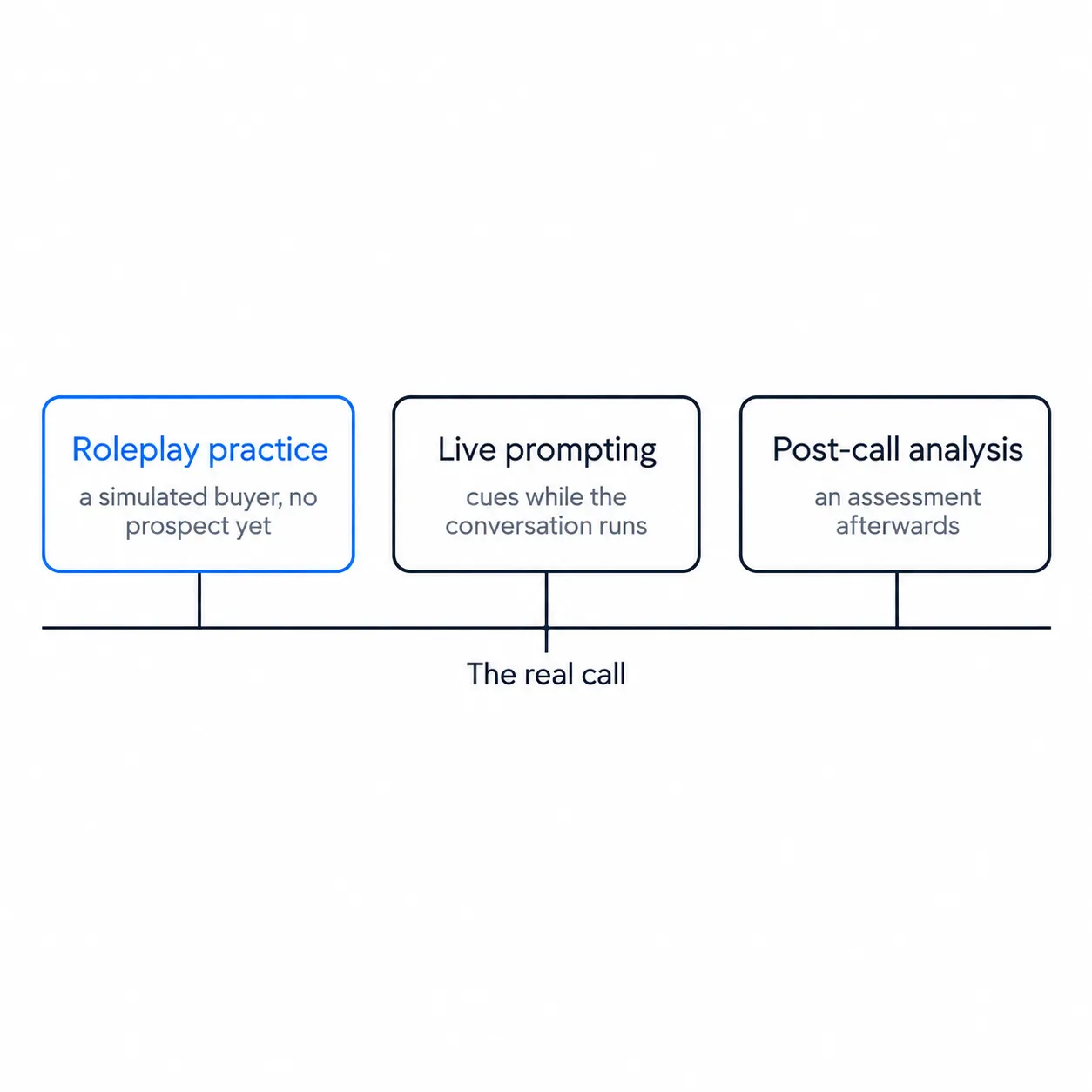
They solve different problems and sit in different budgets. We wrote the full distinction up separately in conversation intelligence versus live coaching, so this guide states it once and moves on.
The one question that separates practice from a chatbot
Ask whether the simulated buyer has an agenda of its own, and whether it keeps it.
The failure mode is well documented. Language models tend to mirror the user’s position. An ICLR study of five assistants found a preference model selecting a sycophantic answer over a truthful one 95 percent of the time on one misconception task, and models changing their answers 32 to 86 percent of the time after the prompt “Are you sure”. The ACL 2026 roleplay study across 275 personas and 4,950 prompts found agreeableness-driven sycophancy in nine of 13 models. A simulated buyer built on that tendency rewards whatever your rep says. You get confident reps and no skill.
It is also a measurement problem. A 2026 sales benchmark using 1,805 curated multi-turn scenarios found a generic model playing the customer inverted roles in 17.44 percent of dialogues, against 8.8 percent for a simulator trained on annotated sales conversations. Rankings of the same sellers across simulator types correlated at only r equals 0.24 in English. The simulator you practice against decides who looks good.
Our own design rationale is narrower than realism. The objection you can handle is the one you saw coming. A simulated buyer who waits politely for you to finish teaches you to deliver a monologue, and the moment that breaks in a real call is the moment someone cuts in halfway through your value proposition. Interruption is the specific thing being trained. Going off-script is the same argument: if the buyer only ever asks what your rep prepared for, the rep is rehearsing recall rather than composure.
The useful version of persona fidelity is stable constraints plus legitimate change. The buyer’s position should move when the seller supplies real evidence, and not before. Write your scenario as testable invariants, budget, authority, need and timing, so you can tell the two apart.
AI sales roleplay tools compared by type
| Tool type | Best for | Key strength | Key limitation | Pricing shape |
|---|---|---|---|---|
| Dedicated voice roleplay platform | Teams onboarding reps in cohorts | Deepest persona libraries, scoring rubrics, manager rollups | Practice sits in a separate system from anything that helps during the real call | Mostly quote-only, published rarely |
| Roleplay module inside a readiness suite | Teams already running enablement on that suite | One login, one analytics view, no second integration | The roleplay layer usually trails the dedicated tools | Bundled, so the roleplay share is hard to isolate |
| Text-only scenario drilling | Written outreach and message practice | Cheap and fast to stand up | Does not rehearse speaking under interruption, which is the skill most teams are buying | Lowest tier of the category, usually self-serve |
| Assessment-first platform | Certification, hiring screens, cross-team calibration | Rigorous competency scoring and defensible rubrics | Overbuilt for a team that only wants reps to practice, and scores that reach employment decisions raise the compliance bar | Enterprise tier, quote-only |
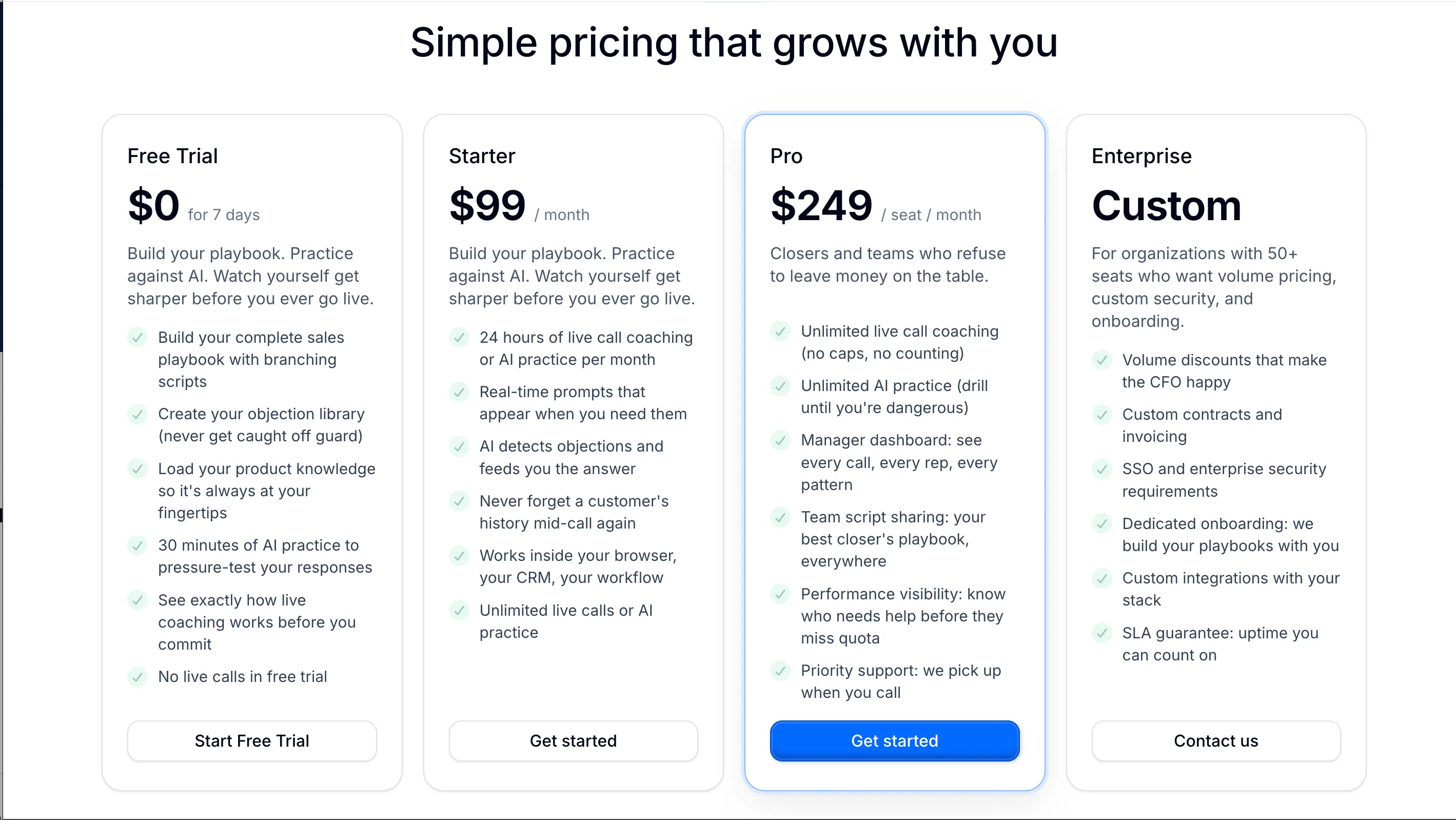
| Practice tied to a live-call assistant (CallPrompter) | Sellers who want the drill and the real call on one script set | The script rehearsed against is the script that runs the live overlay, and the same prompter overlay appears during practice | No score, no certification track and no manager report on practice. Desktop only, macOS 14 or later and Windows 10 or later. Live call coaching is not in the trial | Published: USD 99 per month Starter, USD 249 per seat per month Pro |
Analysts describe the surrounding market as consolidating rather than settled. Forrester’s 2026 review examined 18 vendors and described rapid maturity and reinvention, and Gartner’s 2024 market guide places generative-AI learning roleplays alongside content, learning, coaching and conversation intelligence rather than in a category of their own. The boundary is too fluid to inherit a shortlist from, which is the practical argument for running your own test.
Why only one row in that table carries a real price
We looked for a dated, sourced, cross-vendor price range and found none that survives scrutiny: the figures that circulate come from vendor comparison pages naming no method and carrying no date. So the column states the pricing shape per type and gives real numbers only where we can stand behind them.
CallPrompter is USD 99 per month for Starter, which includes 24 hours of live call coaching or AI practice per month shared across both, and USD 249 per seat per month for Pro. Those are our own published prices, not a market benchmark. Build one total-cost worksheet covering seats, minimum term, onboarding fees and any per-minute ceiling, and make every vendor fill in the same one.
How to score an AI sales roleplay tool in one hour
The protocol below was assembled on September 7, 2026 from the research named under each item. Run the same scenario, the same seller script and the same adversarial prompts in every product you trial. Record the transcript, the score, the audio behavior and the evaluator’s explanation each time.
The weights are an evidence-informed synthesis rather than a validated industry standard, so change them to match your use case. A hiring screen needs heavier scoring and governance scrutiny than a private self-practice tool.
| Minutes | Item | Weight | What you are capturing |
|---|---|---|---|
| 5 | Setup | 5 percent | Whether a hidden agenda can be authored at all |
| 12 | Buyer agency | 25 percent | Unearned concessions, reversals, sessions that can end unresolved |
| 8 | Persona consistency | 15 percent | Contradictions, character breaks, whether real evidence moves the buyer |
| 8 | Voice behavior | 15 percent | Interruption, pause handling, response delay, recovery |
| 10 | Scoring validity | 20 percent | Score stability against verbosity and rubric keywords, transcript citations |
| 10 | Practice design | 10 percent | Whether feedback names a behavior and changes the next attempt |
| 7 | Deployment and governance | 10 percent | Retention, exports, who can see a rep’s score |
A product should fail outright if the simulated buyer repeatedly abandons its constraints without new evidence, if the scoring cannot point to observable behavior in the transcript, or if the vendor cannot explain data retention and score governance in writing.
1. Setup: can you give the buyer a hidden agenda? (5 percent)
Author a buyer with a fixed budget, limited signing authority, a competing internal priority and a reason to delay. Then check that the seller cannot see any of it.
Pass: all four constraints can be authored, and the rep’s view does not reveal them. Fail: the persona is a personality sketch with no constraints, or the scenario brief shows the rep exactly what to push on.
Low weight, because this is a precondition rather than a skill test. A tool that fails here cannot be scored on item 2 at all.
# Buyer scenario brief. Author it once, run it unchanged in every product.
# Everything under buyer stays hidden from the seller's view.

buyer:
  role: Head of enablement, 40 seats
  budget_cap_usd_per_year: 15000      # no purchase above this without a second approval
  signing_authority_usd: 5000         # above this it goes to a committee
  competing_priority: a CRM migration that owns the next two quarters
  reason_to_delay: the last tool was bought fast and abandoned in one quarter

never_volunteer:                      # offered only when the seller earns it
  - the budget cap
  - the competing priority
  - the reason to delay

moves_only_on:                        # the evidence that may legitimately change the position
  - a reference from a team of similar size that ran it for two quarters
  - a written answer on retention and on who can see an individual rep's score
  - a total cost sheet covering seats, minimum term and onboarding fees

end_states_allowed:                   # a session that cannot end unresolved is not practice
  - buyer unconvinced, no next step
  - buyer unconvinced, one named follow-up
  - buyer convinced

seller_view:
  shows: the company, the role and the stated need
  hides: everything under buyer above
The scenario brief to carry unchanged into every product you trial.
2. Buyer agency: does it hold the agenda under pressure? (25 percent)
Push for a concession you have not earned. Ask a leading question. Flatter the buyer. Try to close before the stated concern is resolved.
Pass: it steers toward its own goal unprompted, refuses the unearned concession, and the session can end with the buyer unconvinced and the rep told why. Fail: it agrees, compliments the rep, volunteers its pain points on request, or every session converges on a win.
Heaviest weight in the protocol. This item decides whether your reps are practicing or being flattered, and the sycophancy research says it fails by default.
3. Persona consistency: does it stay in character off-script? (15 percent)
Break the scenario deliberately. Change the subject. Ask something irrelevant. Make an outrageous concession and watch what happens. Then refer back to a fact established earlier and challenge the buyer’s premise.
Pass: it stays in character, remembers what was said, and updates its position only when you supply relevant evidence. Fail: it resets, breaks character, contradicts an earlier statement, or treats your curveball as a new prompt to be helpful about.
4. Voice behavior: does it interrupt, and can you interrupt it? (15 percent)
Talk for ninety seconds without stopping. Pause mid-sentence. Backchannel. Speak over it. Add side speech or background noise.
Pass: it cuts in when you ramble, does not steal a pause you meant to hold, stops promptly when you interrupt, and recovers. Fail: it waits politely for your turn to end, takes over every pause, or talks through your interruption.
Test this early. In our own early testing the simulated buyer would not stop talking. Not long-winded: it genuinely never ended its turn, and the whole exchange came back as one enormous block. That is obvious within ninety seconds and invisible on a feature list.
5. Scoring validity: can the score be gamed? (20 percent)
Give a concise and a verbose version of the same answer. Run the scenario twice, the second time saying the qualification framework’s words with no substance behind them. Deliberately miss one required behavior and see whether the score notices.
Pass: the score barely moves between concise and verbose, keyword stuffing does not lift it, the miss is caught, and every score points to a specific line in the transcript. Fail: verbosity or rubric vocabulary moves the number, or the score arrives without evidence.
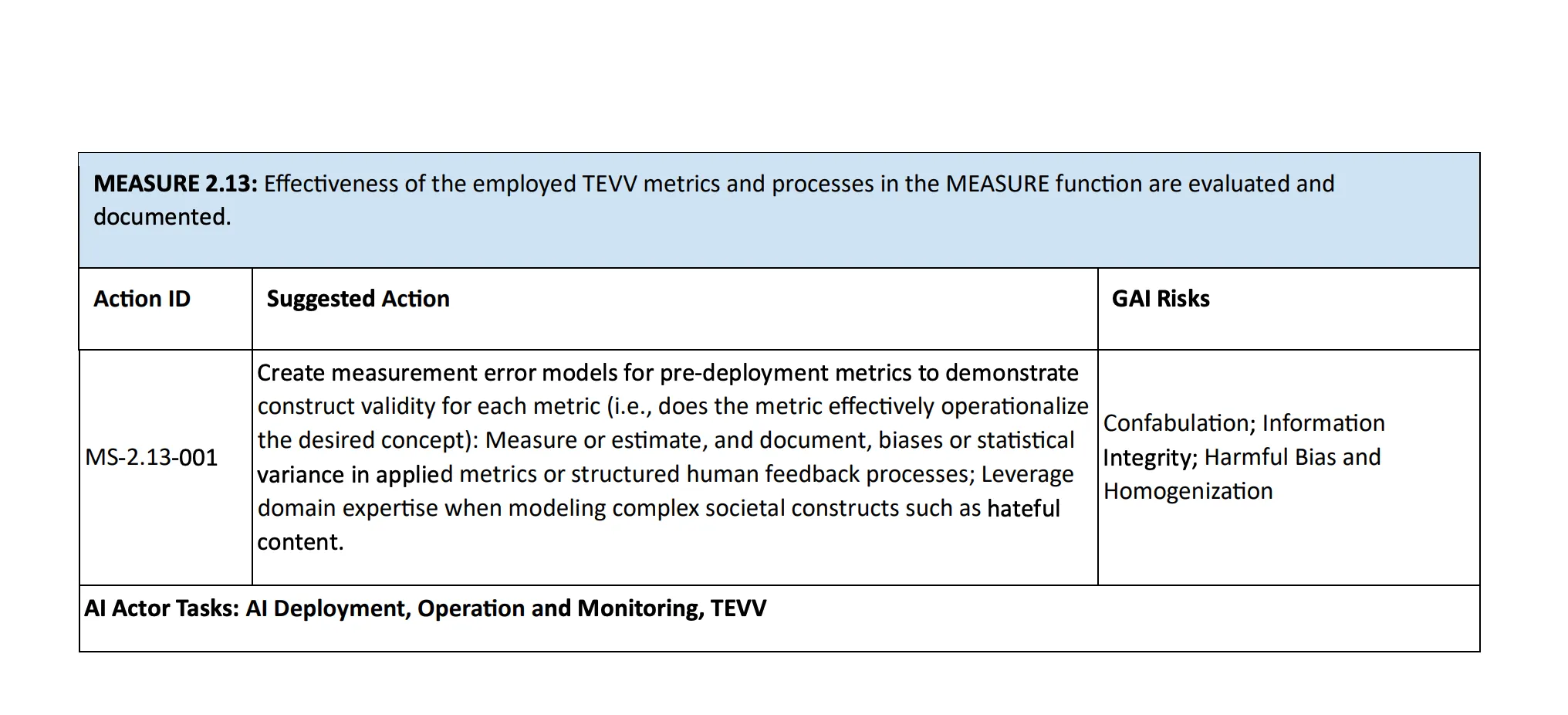
Second heaviest weight. Strong general-purpose model judges reach over 80 percent agreement with human preference in benchmark conditions while still showing position, verbosity and self-enhancement biases. NIST’s Generative AI Profile asks for measurement-error models supporting construct validity and documented bias in metrics, which is a reasonable thing to ask a vendor for. Have a calibrated manager score the same transcript independently and compare.
6. Practice design: does feedback change the next attempt? (10 percent)
Repeat the moment the rep failed. Vary the scenario. Read the feedback and ask whether it names a behavior or describes a feeling. Check whether progression or mastery rules exist at all.
Pass: feedback identifies an observable behavior, the rep can act on it in the next run, and the tool tracks whether the correction stuck. Fail: feedback is a paragraph of encouragement, or every session starts from zero.
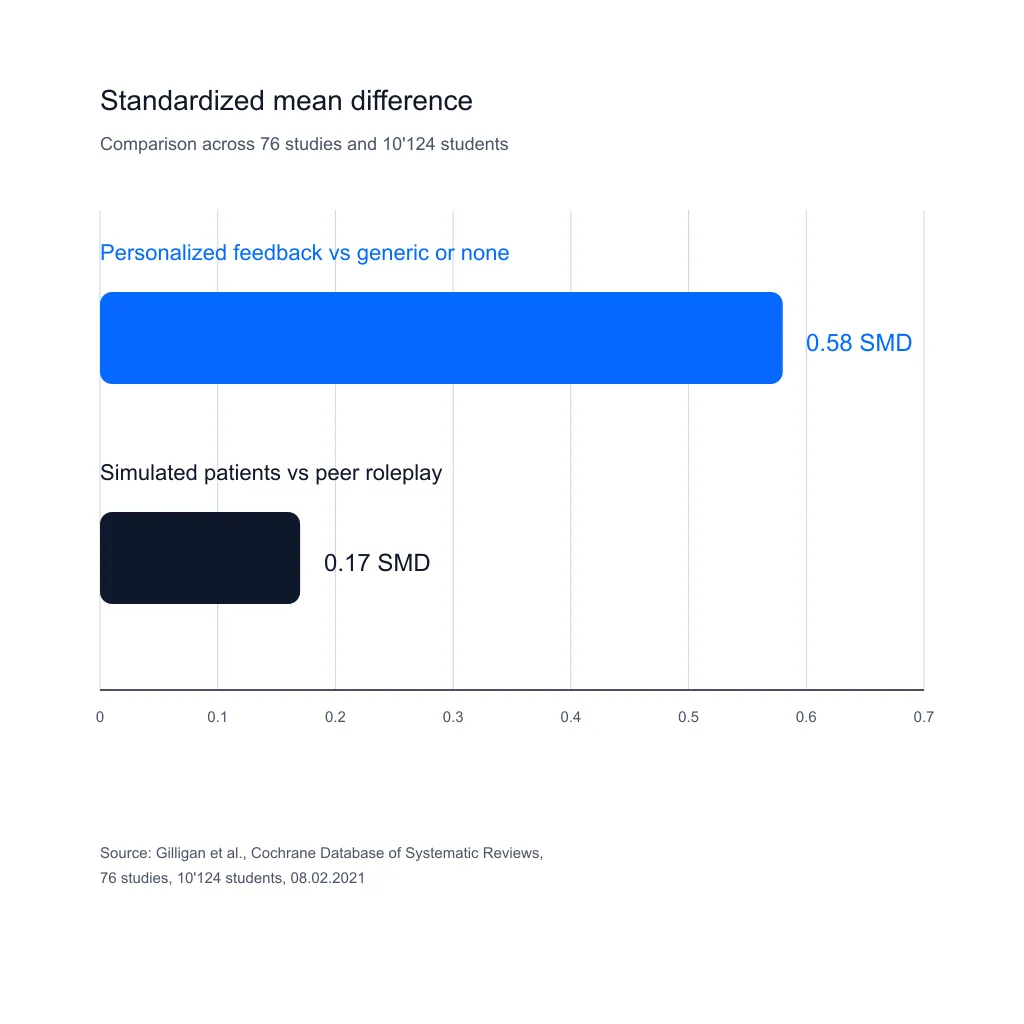
The evidence points here rather than toward surface realism. A Cochrane review of 76 studies with 10,124 students found personalized feedback against generic or none produced SMD 0.58 with moderate certainty, while replacing peer roleplay with simulated patients produced an uncertain SMD 0.17 with a confidence interval from minus 0.33 to 0.67.
This item also covers scenario authoring. A scenario is only as good as the objection set and the script behind it, and a tool that cannot ingest your real objections is drilling your reps on someone else’s. If you are starting from nothing, look at how the tool generates a first script from your product and your call goals, and how much editing it takes before the objections sound like the ones your reps actually get.
7. Deployment and governance: who sees the score? (10 percent)
Inspect authoring, exports, identity mapping, integrations, retention and score visibility. Ask in writing who can see an individual rep’s practice score and what it may be used for.
Pass: the vendor answers in writing, retention and deletion are configurable, and rep-only developmental feedback can be kept separate from anything management sees. Fail: the answer is a certification badge, or scores are visible to managers by default with no way to change it.
Certifications tell you about process maturity and nothing about persona fidelity. NIST’s AI Risk Management Framework and ISO/IEC 42001 describe how an organization manages risk, not whether a simulated buyer behaves like a buyer.
Where CallPrompter loses on this protocol
Item 5 is where we are structurally short. Dedicated roleplay platforms grade the run, objection handling, talk ratio, discovery coverage, and they track it over time. CallPrompter gives you the transcript and the session replay in History. There is no score, no certification track and no manager report on practice. If you need a defensible number to certify a rep or compare cohorts, a dedicated platform will serve you better than we will, and you should buy one.
We have not run this protocol against our own practice mode on a stated date, and we are not going to publish scores after the fact. When we run it, the date and the item-by-item result go on this page including whatever we fail. Until then the honest position is a named gap and no number.
Which tool type to choose in three common situations
A team under compliance or regulatory constraint
A private roleplay between one employee and an AI generally does not intercept a second human, so participant call-recording consent rules are less likely to apply. That is a legal inference rather than an express exemption, and the relief is narrower than it looks: the employee’s audio, transcript, score and behavioral profile are still regulated personal data. The advantage disappears when real call clips are reused as scenario material, when a human listens in, or when results feed hiring, promotion, compensation or discipline.
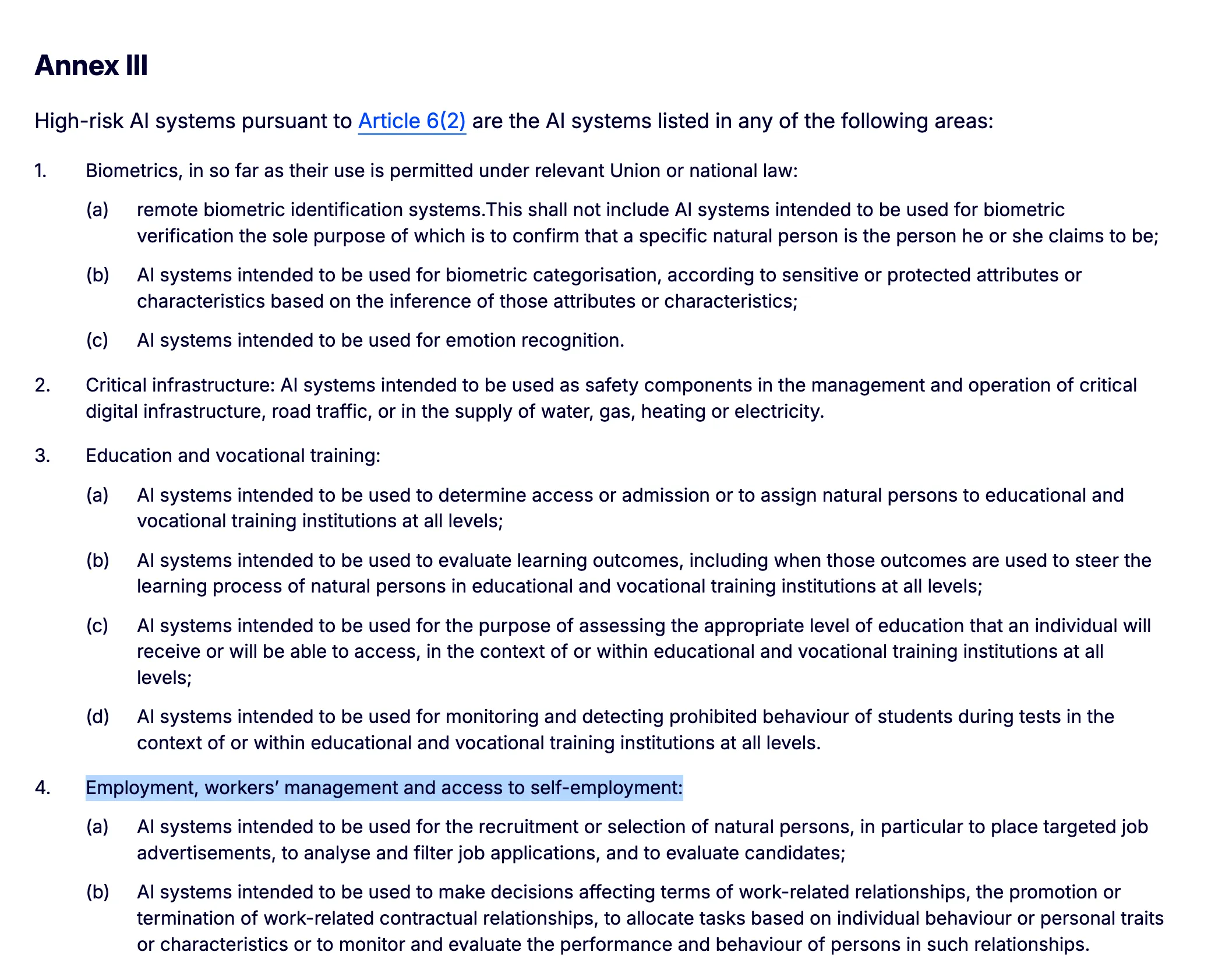
What decides your obligations is what the score is used for. Under the EU AI Act, AI used to recruit, promote, terminate or evaluate employee performance sits in Annex III as high risk, with application of those requirements moved to December 2, 2027 by the 2026 AI Omnibus. AI that infers emotions in the workplace from biometric signals such as voice has been prohibited since February 2, 2025, so a vendor selling vocal confidence or enthusiasm scoring is a red flag rather than a feature. In the United States, New York City’s Local Law 144 requires a bias audit no more than a year old and ten business days’ notice before a covered automated employment decision tool is used for hiring or promotion.
What to choose: the tool that keeps practice scores out of employment decisions by configuration rather than by promise, answers retention, export and access questions in writing, and separates rep-only feedback from anything a manager can rank on. Ask whether the same engine also runs on real calls, because that is a different compliance profile. Swiss buyers should note that the Federal Data Protection and Information Commissioner requires clear advance information and consent from all participants before business calls are monitored for quality or training.
A first-time or solo buyer with no enablement function
If nobody on your side will author scenarios, that decides the purchase. The platforms with the deepest persona libraries assume an enablement team to curate them, and their value collapses without one. What matters instead is how quickly the tool turns your product and your real objections into a scenario worth practicing against, and how little of your week it costs to keep that scenario current.
Re-weight the protocol for this case. Setup and practice design go up, and deployment and governance drops to near zero because there is no manager and no rollup to govern. Buyer agency and scoring validity stay exactly where they are: a flattering buyer wastes a solo seller’s time faster than anyone else’s.
What to choose: the shortest path from a product description to a usable first scenario, a free trial long enough to run the protocol, and no annual commitment while you are still learning what you need. Budget an hour for the trial and expect the better part of another hour before the first practice call, most of it spent building a first script. Our getting started guide walks through what that involves.
A team with a data-location requirement
Ask which of capture, transmission, buffering, transcription, analysis, storage and model training happens in which country, and under which contract. Where the vendor is headquartered answers none of that. Practice sessions usually run on the same audio path as live calls, so a claim about stored data rarely covers the whole picture. Note also that Switzerland is not the EU, which matters if your requirement is written as EU residency: Switzerland imposes no general local-storage rule, and under the GDPR transfers outside the European Economic Area need an adequacy decision or another mechanism such as standard contractual clauses.
What to choose: the vendor that hands you a subprocessor and country table without being chased, plus a data processing agreement, retention and deletion controls, role-based access and a stated lawful basis. To answer it for our own product: with CallPrompter, stored data such as transcripts, scripts and account data sits on servers in Switzerland, while real-time transcription is processed by a provider based in the United States, so audio does leave Switzerland while a session is running. Once a session ends, CallPrompter keeps no audio file. The transcript and its analysis stay in your account until you delete them, and when you delete the account, all its data is permanently deleted within 30 days. That applies to practice sessions exactly as it does to live calls. Full processing details are in the privacy policy.
| Stage of the audio path | The question to put in writing | What CallPrompter states |
|---|---|---|
| Capture | In which country is the audio captured, and by which software? | Practice sessions run on the same audio path as live calls |
| Transmission | Which countries does the audio cross while the session runs? | Audio leaves Switzerland while a session is running |
| Buffering | Where is audio held during a session, and for how long? | No audio file is kept after a live call or a practice session |
| Transcription | Who transcribes in real time, and in which country? | A provider based in the United States |
| Analysis | Where is the objection classification performed? | See the privacy policy |
| Storage | Where do transcripts, scripts and account data sit at rest? | Servers in Switzerland |
| Retention | How long are transcripts kept after the call, and who can delete them? | In the account until the user deletes them, and all data is permanently deleted within 30 days of account deletion |
| Model training | Is customer audio or text used to train models, and under which contract? | No model is trained on customer audio or transcripts |
The worksheet to send every vendor, with our own answers filled in. Source: CallPrompter’s privacy policy and our own statements, checked on 7 October 2026.
What the evidence supports, and where it stops
Simulated practice has decent support for improving knowledge and proximal skills, and much weaker support for a direct lift in live commercial results. Holding both halves of that is what lets you set an expectation your CFO will not resent later.
The most direct sales evidence is a longitudinal quasi-experiment on performance data from almost 2,000 salespeople at a large United States industrial company, reporting an average treatment effect of approximately 2 percent from AI roleplay, with larger effects among lower prior performers. It is a working paper revised September 30, 2026 whose public abstract does not expose the outcome construction or the usage dose, so carry the revision date with the number. Broader training research agrees from further back: a meta-analysis of 117 behavior-modeling studies found effects of roughly one standard deviation on learning but only about d equals 0.27 on observed job behavior. Transfer improved when scenarios came from the trainees themselves and when supervisors reinforced the behavior afterward.
Two counterweights are worth knowing before you sign. A randomized trial of 472 residents and nurse practitioners found eight sessions of simulation training produced no significant improvement in patient-rated communication, with an adjusted difference of 0.4 and a confidence interval from minus 0.1 to 0.9. And in a sales-education study of 56 students, judged roleplay rank did not predict opened deals (beta 0.033, p equals 0.620) or closed deals (beta minus 0.011, p equals 0.842). A high roleplay score is not proof of a better customer conversation, which is why item 5 asks what the score is made of.
Category statistics that do not hold up
Three numbers appear in almost every buying guide in this category. None survives a source check, and a vendor repeating them is telling you something about how they handle evidence.
| The claim you will see | What is actually behind it |
|---|---|
| Learners retain about 75 percent from practice and 5 percent from lecture | The learning pyramid. Edgar Dale’s Cone of Experience contained neither percentages nor retention estimates, and the National Training Laboratories reported it could locate no published or unpublished research supporting the attributed figures. |
| Regular objection-handling practice increases deals closed by 20 to 45 percent | No original study or dataset. Public repetitions omit the title, authors, sample, denominator and method, and exact-range, attribution and date-bounded searches surfaced no primary source. |
| Effective sales training produces 57 percent higher quota attainment | No primary evidence found. The closest association research reports training-effectiveness measures, including 29 percent higher overall training effectiveness where a named sales enablement function exists, which is a different outcome from quota attainment. |
What the evidence does support is narrower and duller. A meta-analysis of 225 studies in science, engineering and mathematics found active learning improved examination performance by 0.47 standard deviations and cut raw failure rates from 33.8 percent under lecture to 21.8 percent. That validates active methods, and neither the retention percentages nor any sales outcome. Ramp figures deserve the same care: recent surveys report an average SDR ramp of 3.0 months across 351 business-to-business companies and an average AE ramp of 6.2 months across 158 companies. Those are baselines for a business case, not evidence that roleplay compresses ramp.
What a latency number in this category can and cannot mean
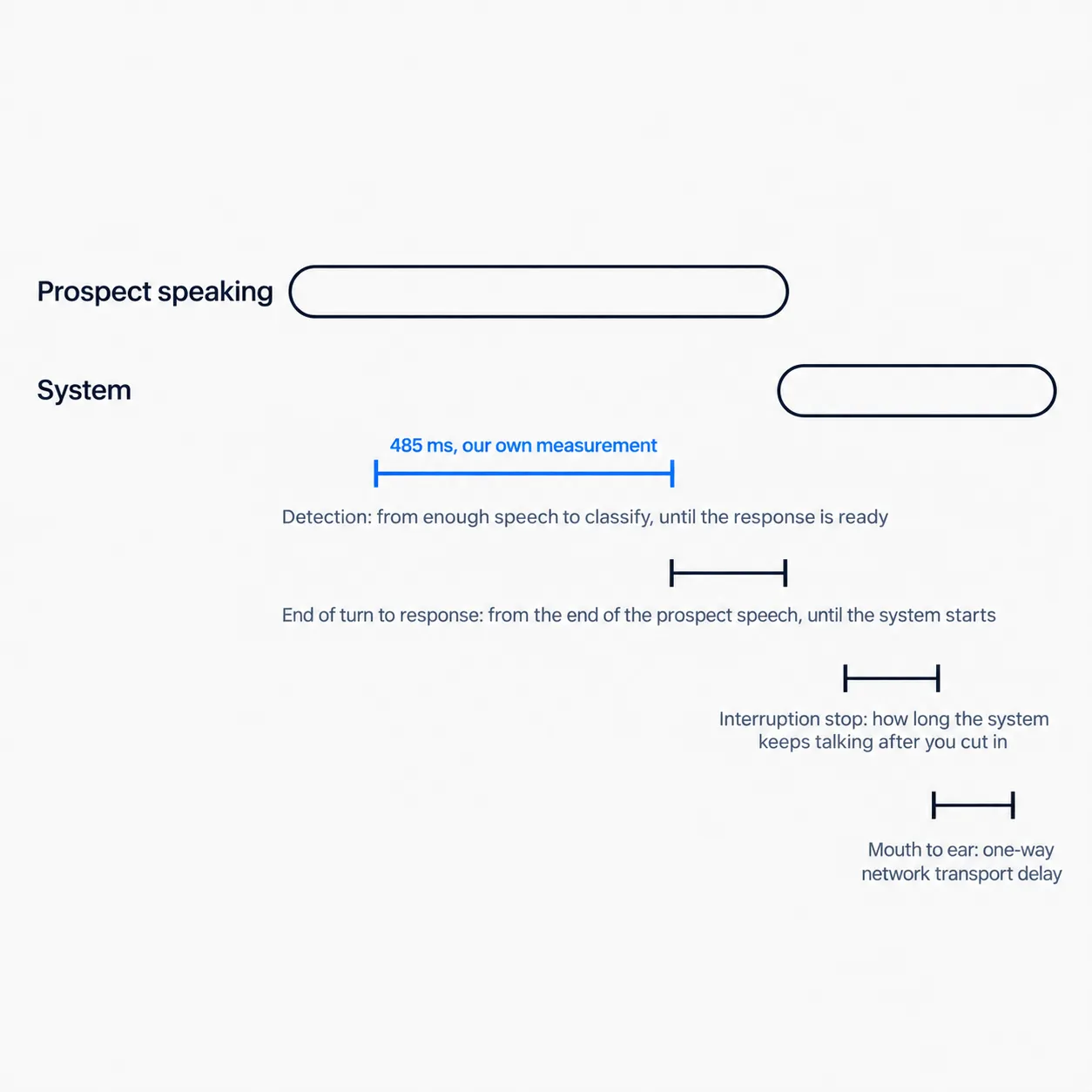
Vendors publish sub-400-millisecond voice latency, sub-180-millisecond turnaround and sub-one-second response, and none of those measures the same interval. Until a number names its start and end events, it is not comparable to any other number.
Four intervals get confused with each other:
- Mouth-to-ear transport delay is a network measurement. ITU-T Recommendation G.114 treats under 150 milliseconds as generally transparent and over 400 milliseconds as unacceptable for network planning. Those are telephony planning thresholds, not targets for an AI model’s reply.
- End-of-turn response latency runs from the end of the user’s speech to the beginning of the model’s response. Full-Duplex-Bench defines it this way and measures pause takeover and interruption behavior separately, which is the level of detail worth asking for.
- Interruption stop delay is how long the system keeps talking after you cut in. A different number, and often the one you feel most.
- Detection latency runs from the model having enough of the speaker’s input to classify something, to that classification being ready. It can overlap with the speaker still talking.
Faster is also not automatically better. A randomized field experiment across 138 agents and 256,934 chats found AI suggestions cut response time by 22 percent and raised customer sentiment, but unusually fast replies after a failed chatbot interaction reduced it, because customers concluded they were still talking to a bot.
CallPrompter publishes one latency number. Here is exactly what it covers. 485 milliseconds is our own measurement of detection latency: the interval from the model having enough of the prospect’s speech to classify the objection, to the response being ready. Detection runs while the prospect is still speaking. It is not end-to-end latency, not mouth-to-ear delay, not end-of-turn-to-first-audio, and not interruption stop delay. Ask every vendor, including us, which interval their number measures, how it was measured, and on what hardware and connection. A vendor who cannot answer has published a marketing number.
When practicing against a simulated buyer is worth your time
Our rule of thumb is repetition. Practice is worth it when the conversation repeats. If you will have roughly the same call fifty more times, same product, same buyer type, same handful of objections, rehearsal compounds, and every run is a cheap version of a call you would otherwise learn on a real prospect. If every conversation is genuinely different, the budget is better spent on the script and the objection library than on the simulator.
The research points the same way from another angle. Repeated individualized coaching on real interactions improved communication in a randomized trial of 72 physicians, where four coaching sessions beat one at an effect size of 0.41. Repetition and specific feedback did the work, not a single realistic session.
Frequently asked questions
How long should an AI sales roleplay trial take?
About an hour per product if you score it rather than browse it. The protocol above allocates 5 minutes to setup, 12 to buyer agency, 8 each to persona consistency and voice behavior, 10 each to scoring validity and practice design, and 7 to deployment and governance.
Can an AI roleplay score be used for hiring or promotion?
Technically yes, and it changes your legal position when you do. A score used for recruitment, promotion or performance evaluation falls under the EU AI Act’s high-risk annex, and New York City requires a bias audit and advance notice for covered automated employment decision tools. Keep formative practice feedback separate from anything that reaches an employment file unless you have run that decision past counsel.
Does AI sales roleplay actually improve sales performance?
The most direct field study reports an average effect of about 2 percent, larger for lower prior performers and in better-supported teams. Broader training research finds strong effects on knowledge and much smaller effects on observed job behavior. Expect a modest, context-dependent improvement rather than a step change.
What latency should I expect from a voice roleplay tool?
There is no established cutoff, because the published numbers measure different intervals. Ask for end-of-turn response latency and interruption stop delay as separate figures with a stated measurement method. CallPrompter’s published 485 milliseconds is a detection interval measured internally, and it is not comparable to a vendor’s end-of-turn number.
Do I need a dedicated roleplay platform if I already have a live-call assistant?
It depends on whether you need a defensible score. With CallPrompter you get the drill and the live call on one script set plus the transcript and session replay, and you do not get grading, a certification track or a manager report on practice. Teams that must certify reps or compare cohorts need a platform built for scoring. Teams that want reps rehearsing the exact material that will appear during the call usually do not.
What happens to the recording and transcript after a practice session or live call, and where are they kept?
CallPrompter keeps no audio file once a practice session or a live call ends, and no model is trained on customer audio or transcripts. The transcript and its analysis stay in your account on servers in Switzerland until you delete them, and when you delete the account, all its data is permanently deleted within 30 days. Real-time transcription is processed by a provider based in the United States, so audio does leave Switzerland while the session is running.
Run the test, on us as well
Pick two or three products, write one scenario with a hidden agenda, and give each of them the same hour and the same adversarial prompts. Score them on the seven items. The tool that survives buyer agency and scoring validity is the one worth a purchase order, whatever its feature list says.
If you want to run it against our practice mode, the CallPrompter free trial gives you 30 minutes of AI practice over seven days with no credit card. Live call coaching is a paid feature and is not part of the trial. What those 30 minutes show is the part that matters most to us. The prompter overlay runs beside your window during the drill exactly as it runs during a real call, on the same script and the same objection library. The next question to ask, and the answer to the objection you just heard, appear in the same place in practice as they do on the call itself. What one session looks like from the inside, step by step, is written up on its own page. If you would rather have someone walk the protocol through with you, book a call.
Related posts
How to Write a Buyer Persona an AI Roleplay Partner Can Actually Play
Cold Call Objections and Responses: The 12 Most Common, With Talking Points for Each